
New group to take fresh approach to wildfires
A new cross-border commission has been launched by the UK’s Regional Moorland Groups to establish what effective, practical wildfire fuel load management looks like across the country’s upland landscapes.
Crucially, it is also considering how it can be delivered at scale.
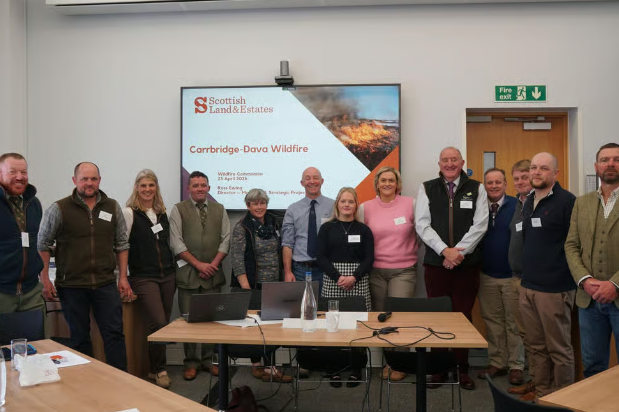
Regional moorland group co-ordinators at the commission meeting.
The Wildfire Commission held its inaugural meeting in Londonrecently, bringing together land managers, fire and rescue services, and leading academics. The commissioning programme will focus on one of the most critical, and controllable, elements of wildfire behaviour - fuel load.
With the severity of wildfire incidents increasing, the Commission aims to move towards a shared understanding of how fuel can be managed to reduce risk, improve containment and protect communities.
The initiative will examine how fuel loads are measured, distributed and managed across moorland - and how this knowledge can be translated into practical, regionally tailored management plans that are genuinely useful to fire and rescue services.
Mark Ewart, national engagement manager for Scotland's Regional Moorland Groups, said: “This commission is about cutting through the noise and focusing on what actually makes a difference on the ground. We know that weather and topography will always play their part, but fuel load is the factor we can influence. If we are serious about improving resilience and protecting lives, it has to sit at the heart of how we plan for wildfire.”
Iona McGregor, regional co-ordinator for the Angus Glens and Grampian Moorland Groups, added: “From a practical land management perspective, there is a clear need for a more consistent and shared understanding of how fuel behaves across different landscapes, and what can realistically be done to reduce risk before a fire starts.
“This commission is an important step forward because it is grounded in real-world experience. It is about bringing together those who manage the land, those who respond to fires, and those who study them - and making sure that knowledge translates into practical action on the ground.”
A series of regional workshops is now planned to produce workable approaches for different moorland environments.
This article originally appeared on Angus County World.